Follow a compact gantry palletizer from editable native sources to measured placement. Open the project, inspect the controller and check the evidence for yourself.
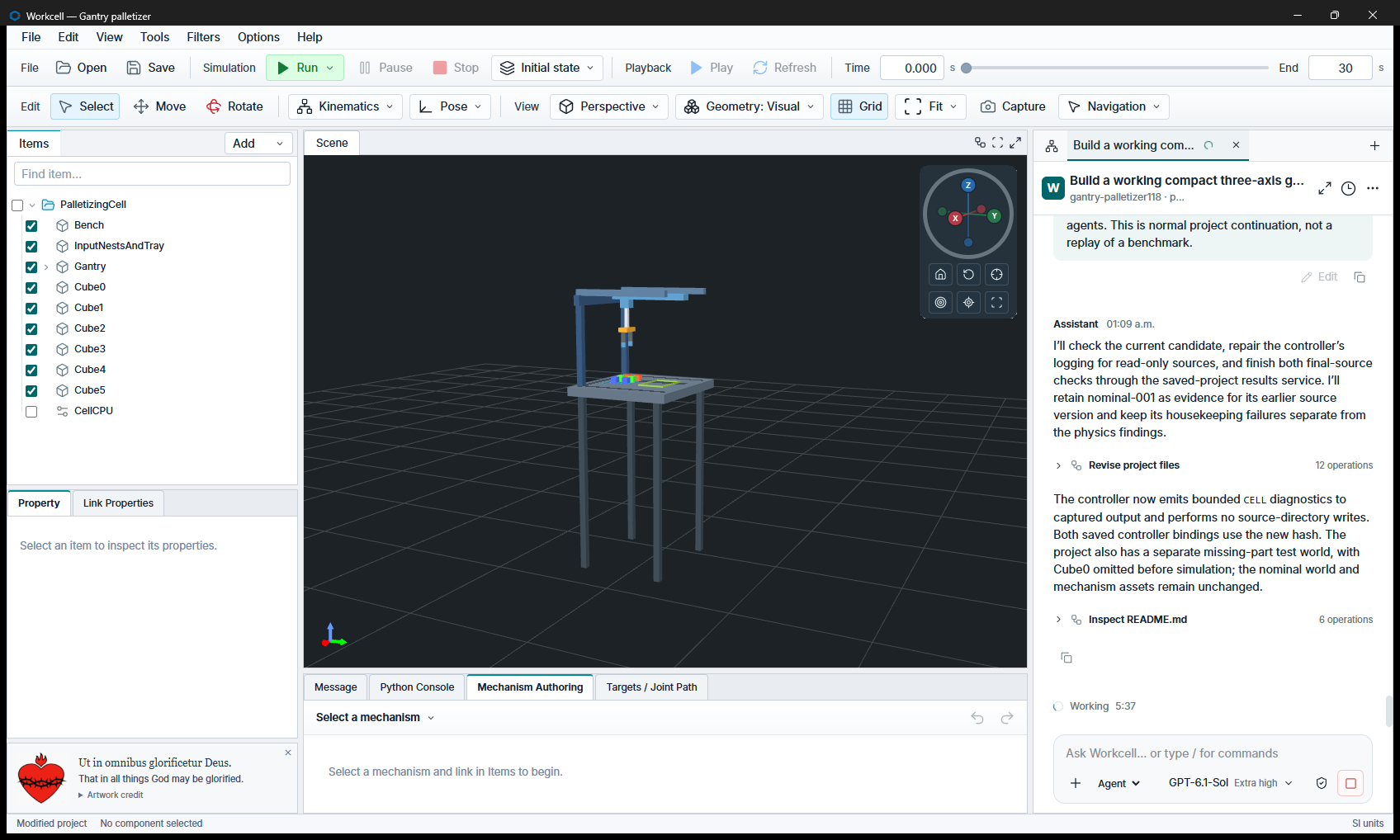
Genuine private Workcell Owner session: the editable cell and real Sol 6.1 / extra-high activity. The view shows the authored initial arrangement; placement and fault results below come from separate retained native recordings, not this still image.
THE ENGINEERING QUESTION
Can the cell pick, carry and place every part?
A three-axis gantry and actuated parallel gripper transfer six free cubes from input nests into a 3 × 2 tray. The controller must use measured feedback, confirm grasping and stop truthfully when a part is missing.
No workpiece teleporting, hidden attachments or physical robot control. This is an internal simulation demonstration—not a customer deployment or safety certification.
Workpieces
6 cubes · 25 mm · 30 g each
Tray layout
3 × 2 · 50 mm pitch
Placement acceptance
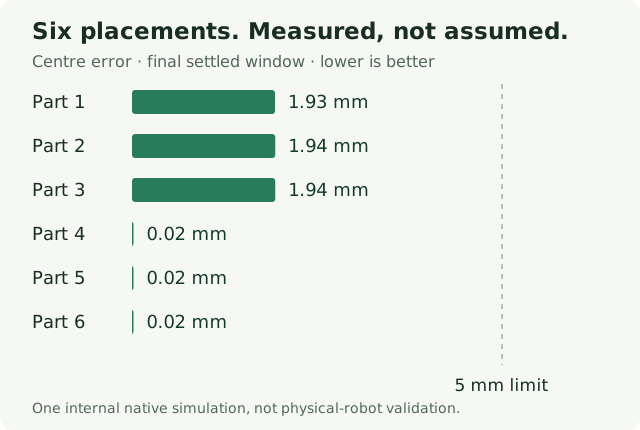
Within 5 mm, settled for 0.5 s
Execution route
Private Workcell Agent · Sol 6.1 · extra-high
WHAT ACTUALLY HAPPENED
Results, with their conditions.
Recorded values come from the saved native simulation—not a rendered animation or the Agent’s own assessment.
Six-part transfer
Six free parts reach their assigned tray locations in the 110-second native recording. Independent checks use measured object centres, contact, joint state and effort—not occupancy flags alone.
Removing the first workpiece produces a fault after the declared grasp deadline. The remaining recording shows stationary joint holding and no false occupancy commits.
Derived from the retained native observations. The first row settles around 1.94 mm from its targets; the second row around 0.02 mm. Both are within this example’s 5 mm acceptance—not a product-wide accuracy claim.
KEEP THE REASONING CHECKABLE
The useful part is in the details.
Inspect the mechanism, finite actuator limits, controller states and run data together. The example keeps unsuccessful approaches and repairs separate from the final accepted run.
A grasp needs evidence.
The controller combines measured jaw force, jaw gap and settling. Independent native contact and object-height observations confirm transport; closed jaws alone are not a pass.
Keep placement separate from bookkeeping.
Slot reservations prevent reuse, but acceptance comes from all six measured centres, final release and a settled observation window. The example keeps the 5 mm tolerance explicit.
A missing part must not become a success.
The fault test removes Cube0. The native event occurs at 4.606 seconds, 2.002 seconds after closing began, with no placement commit and a measured stationary hold.
YOUR NEXT STEP
Open it. Run it. Change it.
The MIT-licensed repository includes the native project, controller, SI parameters, measured evidence and reproduction instructions. The application itself is not included.
The example was engineered using the private Owner Agent. It does not make public Client AI available; local native engineering remains free.